

The Paradox Of Luck
Are we lucky, or not ?

"The universe seems neither benign nor hostile, merely indifferent to the concerns of such puny creatures as we are"
It is quite lucky to be alive, or is it? It is quite lucky to live on a planet like Earth, or is it? It is quite lucky to orbit a relatively calm star at just the right distance, or is it? It is quite lucky to be located in a quiet neighborhood of our galaxy, or is it? It is quite lucky to exist in a universe that did not collapse back into nothingness, or is it?
Growing Up Lucky
Since our inception as a child, we’ve been told how lucky we were to live on a planet like earth, that shields us from all sorts of whatsits that can make us write a book titled “a million ways to die.“ When we grew up a little, we heard that we were lucky enough to live just far enough from a star, that made liquid water possible, just imagine life without water, no fizzy drinks, no coffee, only extra hard mondays. When we grew old enough to go for a movie (alone of course), we were told that our luck could never run dry as for a third time in a row, our star system was coincidentally situated at a place in our galaxy, where things are relatively jolly good. One day, after all this, we came across some popular science books that made us feel sooo damn lucky as our universe never gave-up, it did not vanish into nothing. Sorry to break it to you, but, we are not lucky, our existence is not mere luck, it is a fact.
2. The Lucky Universe
The universe appears finely tuned for complexity. This is not controversial. The strength of gravity, the charge of the electron, the cosmological constant and several other parameters lie within narrow ranges that allow matter to clump, stars to ignite and heavy elements to form. In many hypothetical universes with slightly different values, the cosmos would be sterile, filled with radiation, or thin gas, or just pizza (has a non zero probability), or nothing at all.
This observation often inspires awe and sometimes discomfort. Why should the universe be so accommodating? Why does reality seem to “care” about our existence?One tempting answer is luck. Another is design. Both are emotionally satisfying and both miss the point. The critical idea is simple, a universe incompatible with observers cannot be observed.
We do not find ourselves in a universe that permits life because it is rare or special. We find ourselves here because this is the only kind of universe in which finding oneself is possible. Universes that fail to develop structure contain no astronomers, no philosophers and guess what, no Substack users pondering their improbability.
This reasoning is formalized in what is known as the anthropic principle. Stripped of philosophical excess, it says nothing mystical. It simply acknowledges a selection effect. Observations are conditioned on the existence of observers. Calling this “luck” is like calling it lucky that every person who has won a race happened to cross the finish line. Those who did not, never show up to be counted. The universe does not owe us an explanation for why it permits life. It merely demonstrates that life-permitting conditions are the precondition for asking the question in the first place (duh..).
3. The Lucky Solar System
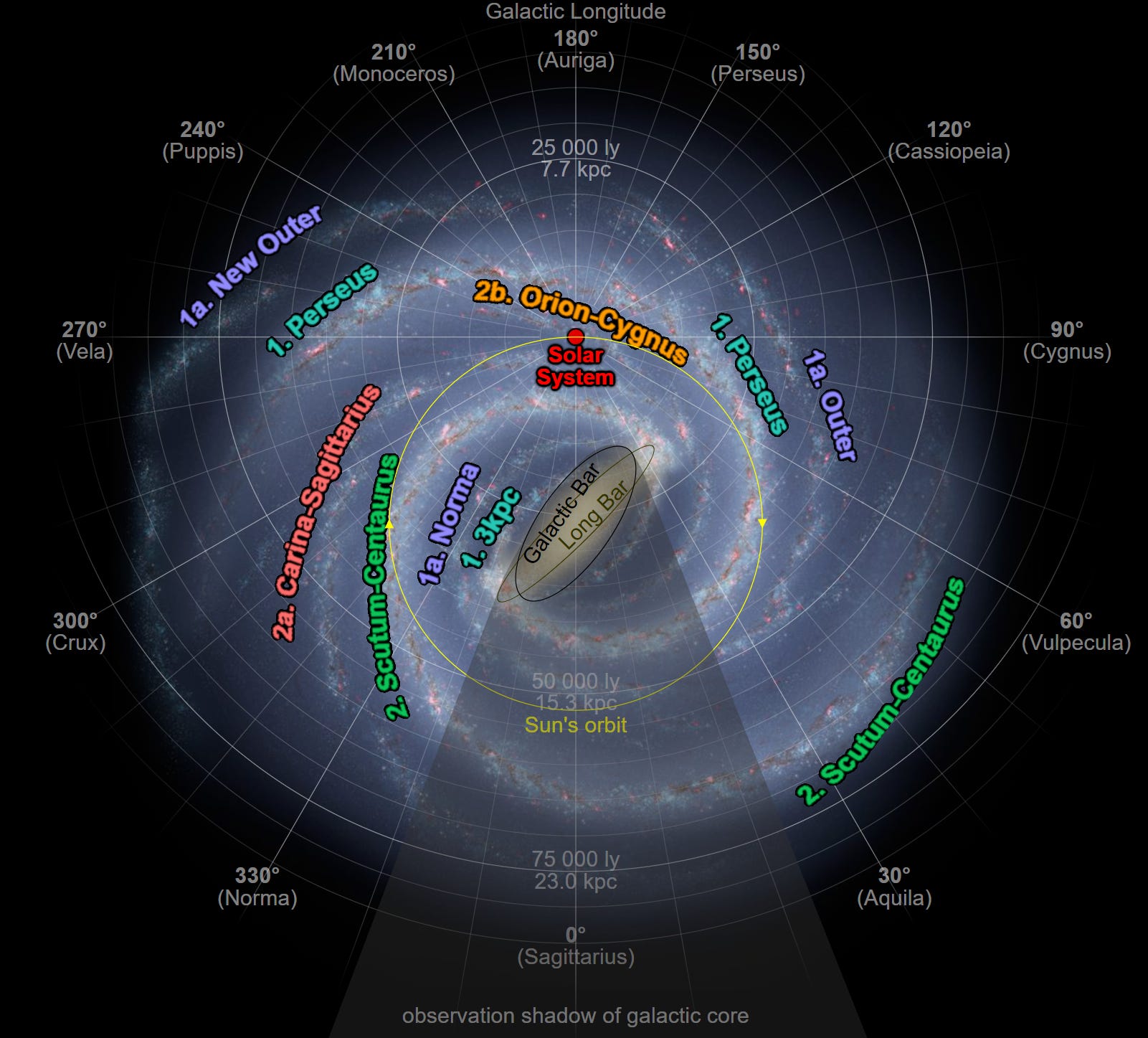

The universe sets the stage for the Solar System to provide the local environment, and here, again, we are told how fortunate we are.
Our Sun is a middle-aged, middle-mass star. It burns steadily, without violent outbursts. Its lifetime is long enough for biological evolution to proceed at a leisurely pace. The planetary orbits are relatively circular and dynamically stable over billions of years. There are no frequent close stellar encounters to disrupt this delicate arrangement.
Zoom out further and the story becomes even more flattering. The Solar System is located not in the crowded, chaotic central regions of the Milky Way, but in the Orion Spur, a minor spiral arm segment situated between the Perseus and Sagittarius arms. This region is comparatively calm. Supernovae are rarer. Stellar densities are lower. Gravitational disturbances are less frequent.
Had our Solar System formed closer to the galactic center, intense radiation and frequent stellar interactions could have stripped planets of their atmospheres or prevented stable planetary systems from forming at all. Had it formed in a more active spiral arm, close passes by massive stars could have repeatedly reset biological evolution through catastrophic events. Once again, the conclusion seems obvious, extraordinary luck.
But this conclusion quietly assumes something false, that Solar Systems form randomly and that observers later roll the dice to see where they ended up. In reality, observers only arise in places where long-term stability exists. Chaotic regions of the galaxy do not host civilizations capable of reflecting on their misfortune. They simply host silence. The Orion Spur is not “lucky” because it is calm. It is noticeable because calm regions are where noticing happens.
4. The Lucky Earth
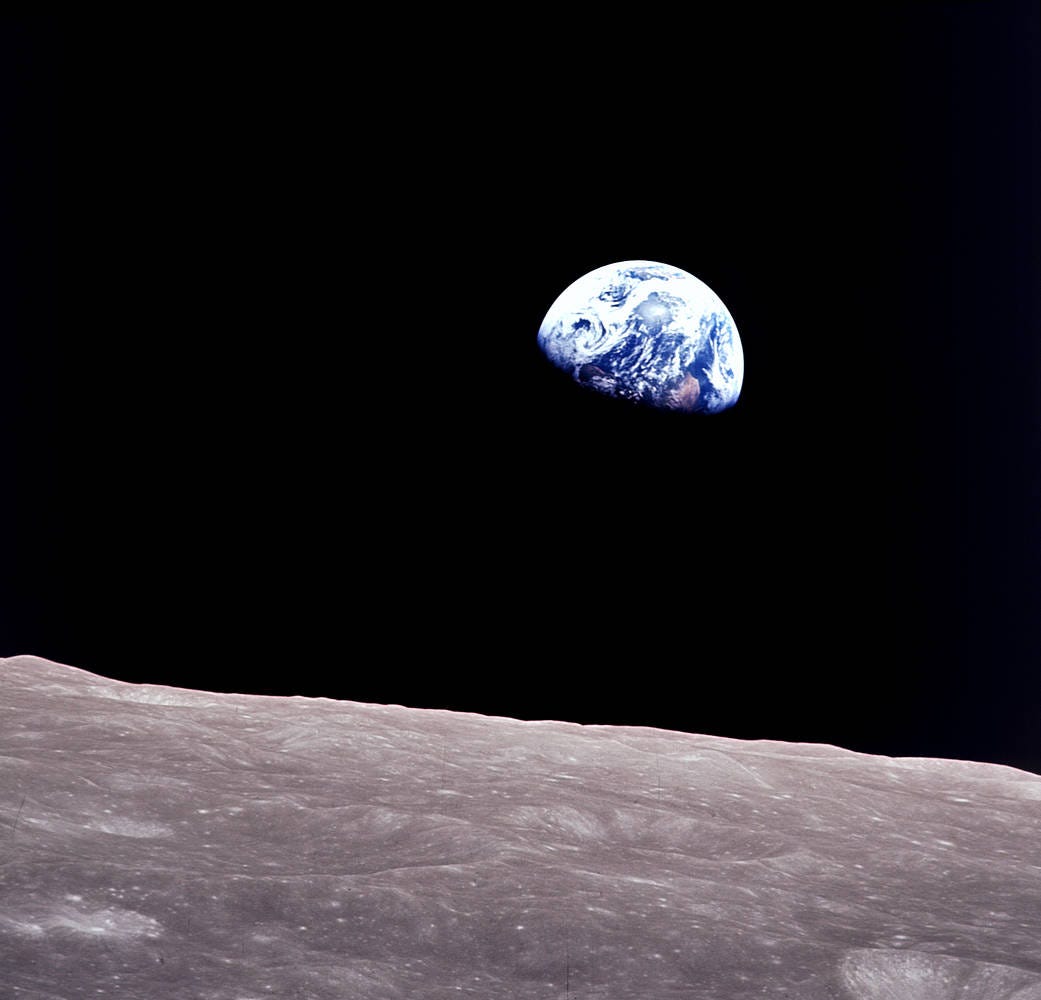
Earth often takes center stage in this narrative and understandably so. It possesses a remarkable collection of features, liquid water, a stable climate over geological timescales (not for long at this pace), plate tectonics that recycle carbon, a large Moon that stabilizes axial tilt and a magnetic field that shields the surface from solar and cosmic radiation. Remove any one of these and life as we know it might struggle or fail entirely. Stack them together and Earth begins to look improbably perfect. But once again, perfection is inferred only because failure leaves no witnesses.
Earth is not special because it is rare. It is special because it is inhabited. If life had arisen on a different planet with slightly different conditions, that planet would be the one writing crappy essays about its own exceptionalism.
This is not to say Earth-like planets are common or rare, we genuinely do not yet know. It is to say that rarity does not imply luck and abundance does not imply inevitability. The presence of observers guarantees that at least one planet somewhere met the necessary conditions. From the inside, inevitability always feels like fortune.
5. The Core of the Paradox
The Lucky Paradox arises because we mistake conditional necessity for cosmic coincidence. Every time we say “we are lucky that X happened,” we implicitly ignore all the cases where X did not happen and where, consequently, no one was around to notice. This creates a powerful illusion. Survivors always appear fortunate when the dead leave no testimony (dead men tell no tales).
Our existence does not require the universe to be generous, benevolent or even especially accommodating. It requires only that somewhere, sometime, conditions allowed complexity to emerge. Once that happened, reflection was inevitable.
6. The Lucky Human
At the end of the chain of supposed coincidences stands the most personal claim of all, that we are lucky to be human. We are told that intelligence, self-awareness, language and curiosity are extraordinary accidents of evolution. That among billions of species, only one learned to ask questions about the universe. From this perspective, being human feels like winning the ultimate lottery.
But this, too, is a retrospective illusion. Human intelligence did not emerge despite evolutionary pressures, it emerged because it worked. On a planet that remained stable long enough, flexible cognition became advantageous. Tool use, cooperation (a dying trait presently), language and abstract thought were not gifts, they were selected. Had they not improved survival, they would have vanished like countless failed traits before them.
We notice ourselves not because we are rare, but because awareness is a prerequisite for noticing at all. Any species capable of reflection would arrive at the same conclusion, mistaking inevitability for fortune. We are not lucky to be human.
We are human because the conditions allowed observers to exist. And in a universe that permits observation, someone was always going to be asking these questions.
Luck is just another name for probability, it is just less odds in favour. Okay…….just….. dont think too much about it, you have much better things to do.
“May the odds be ever be in your favour.“

For Hard Core Nerds
1. Urbanowski, K., 2023. Multiverse as an ensemble of stable and unstable Universes. Symmetry, 15(2), p.473.
2. Lineweaver, C.H., Fenner, Y. and Gibson, B.K., 2004. The galactic habitable zone and the age distribution of complex life in the Milky Way. Science, 303(5654), pp.59-62.
3. Fischer, D.A. and Valenti, J., 2005. The planet-metallicity correlation. The Astrophysical Journal, 622(2), p.1102.
the new logo looks very interesting!
This takes the romance out of “luck” without flattening the awe. By keeping the focus on selection rather than favor, it reframes existence as conditional rather than gifted.
What works here is the steady insistence that survivorship distorts perspective. From the inside, contingency feels miraculous. From the outside, it’s simply the only place observation could occur.